Search for the best outdoor infrared sauna and you mostly get maker collection pages and general outdoor sauna roundups where the infrared cabins are an afterthought. What I couldn't find in one place was a side-by-side of what each listing actually says about weather protection, winter use and the circuit it needs, with a "not shown" where the page stays quiet. That's the angle here, and every number below traces to a page I opened on 2026-10-07.
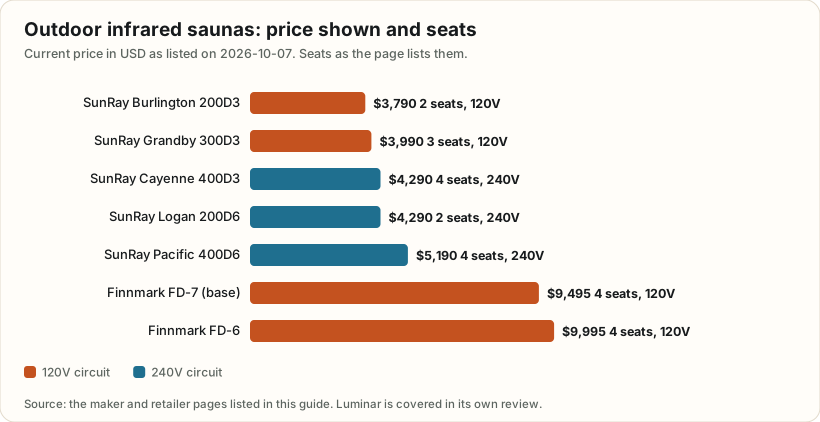
I cover seven cabins and barrels, from a $3,790 two-seater to a $9,995 four-person barrel, plus the Sun Home Luminar, which I've already reviewed and only link to. An outdoor infrared sauna is a plug-in or hardwired cabin with a weather-sealed shell and no stove, so the questions that matter are the outlet, the base and what the exterior wants from you every year. Prices are a snapshot and they move.
Best outdoor infrared sauna: quick picks
| Model | Seats | Price shown | Heater and power listed | Circuit listed | Cabin warranty shown | Max temp listed |
|---|---|---|---|---|---|---|
| SunRay Burlington 200D3 | 2 | $3,790 (was $5,685) | 6 far-infrared heaters, 1,900W (manual table 1,800W) | 120V, dedicated 20A | 10 years structure | 140°F |
| SunRay Grandby 300D3 | 3 | $3,990 (was $5,985) | 7 far-infrared panels, 2,100W | 120V, dedicated 20A | 10 years structure | 140°F |
| SunRay Cayenne 400D3 | 4 | $4,290 (was $6,435) | 10 far-infrared heaters, 2,400W | 240V, 30A dedicated | 10 years structure | 140°F |
| SunRay Logan 200D6 | 2 | $4,290 (was $5,985) | Carbon far infrared, 2,800W | 240V, 20A dedicated | 7 years structure | about 140°F |
| SunRay Pacific 400D6 | 4 | $5,190 (was $6,985) | Far-infrared panels, 4,800W | 240V, 30A dedicated | 10 years structure | 140°F |
| Finnmark FD-7 | 4 | $9,495 base | 5 Spectrum Plus panels, 350W each | 120V, 15A, NEMA 5-15P | 10 years comprehensive | 170°F |
| Finnmark FD-6 | 4 | $9,995 | 5 Spectrum Plus panels, 350W each | 120V, 15A | 10 years comprehensive | Not shown |
The Luminar 2-person, which I don't repeat as a main entry, is $11,599, 240V and 20A with a GFCI requirement, and the maker says it operates below 25°F. My Sun Home Luminar review has the fine print.
How I picked and what I can't claim
I haven't sat in, assembled, heated or left any of these out in a storm. I'm not an engineer or an electrician, and nothing here replaces an installer's quote or your local code. When I write "the maker says" or "the listing shows", that is all I know.
I started with Topture's outdoor infrared collection, which lists five cabins, all from SunRay. SunRay's own site lists the same five at the same prices, and Sun Valley Saunas lists four of them at those prices as well, which is a useful cross-check. For the non-SunRay entries I needed a page with a price, a seat count and an electrical line, so I took the two Finnmark barrels from Sun Valley's outdoor infrared collection. I ordered by evidence, meaning how much each page tells you about weather, circuit and warranty, and not by who sells it. I skipped the Golden Designs outdoor models in that collection because they are listed as hybrid cabins, they run from $14,999 up, and I didn't open their pages. I also skipped the Luminar 5-person, listed at $13,999 there, because I haven't read its spec page.
Here is what I could not verify across the group, and the list is long:
- Any winter operating rating for the SunRay cabins. The SunRay outdoor page says the cabins are "weather-resistant infrared cabins designed to live outside", and its Burlington page shows winter statements as absent.
- GFCI wording on any SunRay or Finnmark page. None of the five Topture pages gave a plug type or GFCI line.
- EMF figures. The SunRay pages show none, and the Finnmark pages say third-party EMF testing documentation can be downloaded, which I didn't open.
- Snow load, wind rating and the base each maker wants. No page I opened specified a foundation.
- Real heat-up times at low temperatures. I have a retailer's generic guide, nothing model-specific.
- Noise, durability after a few winters, and how any of these hold up in a wet climate.
SunRay Burlington 200D3: the cheapest two-seater
Topture lists the Burlington at $3,790, down from $5,685, for two people. The cabin is 47" wide, 45" deep and 87" high, with a roof footprint of 67" by 59", an interior of 43" by 41" by 68" and a shipping weight of 301 lbs. It has six far-infrared heaters, listed at 1,900W on the product page and 1,800W in the manual's specification table, so the listing disagrees with itself. The maker's own site agrees with 1,900W.
On the circuit, Topture shows 120V (written as 110–120V) on a dedicated 20A line and no plug type. Dividing 1,900W by 120V gives 15.8 amps, about 79% of a 20A breaker (my arithmetic: 1,900 / 120 = 15.8, and 15.8 / 20 = 0.79). Even the 1,800W figure comes to 15.0 amps (my arithmetic), so a standard 15A circuit has no headroom either way.
The weather wording is the clearest of the SunRay set. Topture says "built for outdoor placement: sealed Canadian hemlock under a metal composite roof" and that the weather sealant wears with exposure, with resealing recommended every year or as needed. The SunRay page says "sealed weatherproof finish and metal composite roof for long lasting durability against the elements". The warranty is 10 years on the structure and 1 year on parts and electronics, residential use only and non-transferable. Assembly is about two hours with two adults, and delivery is curbside freight with a lift gate, free in the continental US.
Drawbacks I can derive: the listed 140°F maximum is the same as the other SunRay cabins and well under the 170°F on the Finnmark FD-7, the one-year parts and electronics term is short for something that sits outside, and per seat it costs more than the larger SunRay cabins, $1,895 against $1,330 for the Grandby (my arithmetic: 3,790 / 2 and 3,990 / 3).
Check price at ToptureAffiliate link
SunRay Grandby 300D3: three seats on a 120V line
The Grandby is $3,990, down from $5,985, for three people. Cabin size is 69" by 47" by 87", the roof footprint is 79" by 61", the interior is 55" by 43" by 68", and the shipping weight is 425 lbs. The listing shows seven far-infrared panels at 2,100W total, 120V (110–120V) and a dedicated 20A circuit that nothing else may share, with no plug type.
That load is 17.5 amps, or 87.5% of a 20A breaker (my arithmetic: 2,100 / 120 = 17.5, and 17.5 / 20 = 0.875). It's the heaviest draw on a 120V outdoor cabin in this roundup, so a slightly long or undersized run matters more here than on the Burlington. I'd ask an electrician about wire size for the distance before I bought it.
The weather wording is where this page does something the others don't. It describes "a sealed weatherproof cabin and a metal composite roof", says the sealant wears with exposure, and the warranty line requires "annual resealing for outdoor saunas sold without a weather cover". That's a maker condition attached to the warranty, so a skipped reseal could cost you coverage. I couldn't tell from the page whether a cover is sold with the cabin, so ask. Structure is 10 years, parts and electronics 1 year.
Check price at ToptureAffiliate link
SunRay Cayenne 400D3: four seats, 240V and the lowest price per seat
The Cayenne is $4,290, down from $6,435, for four people. The cabin is 79" by 52" by 87", the roof footprint 89" by 67", the interior 65" by 48" by 68", and the shipping weight 552 lbs. It has ten far-infrared heaters and 2,400W total, on 240V (written as 220–240V) and a dedicated 30A circuit, with no plug type shown. The heater element type isn't published.
Per seat it's the cheapest listing here at $1,073 (my arithmetic: 4,290 / 4 = 1,072.5), and the electrical load is gentle: 2,400W at 240V is 10 amps, a third of the 30A it asks for (my arithmetic: 2,400 / 240 = 10). The odd part is that the circuit is bigger than the load, which I'd ask SunRay about, since an installer will quote 30A wire and breaker for a cabin that draws 10 amps.
The page says "sealed weatherproof cabin", "weather sealant deteriorates with outdoor exposure" and that the exterior should be resealed annually or as needed. Warranty and assembly match the Burlington: 10 years structure, 1 year parts, about two hours. The cabin lists a heat-up of 8–15 minutes, without saying from what starting temperature. I'd read that as an indoor-style figure until the maker says otherwise.
Check price at ToptureAffiliate link
SunRay Logan 200D6: the 240V two-seater with the shorter warranty
Logan is $4,290, down from $5,985, for two people. It's 66" wide by 69" deep by 88" high outside with a 49.25" base, a 45" by 45" by 73" interior and a weight of 361 lbs. The page says carbon far-infrared elements at 2,800W, 240V, a dedicated 20A circuit and a maximum of about 140°F. It also lists chromotherapy lighting, a Bluetooth sound system and an air purifier.
At 240V the 2,800W is about 11.7 amps (my arithmetic: 2,800 / 240), so it sits at roughly 58% of a 20A line. That's comfortable, but a 240V circuit is more work than a 120V one. Compared with the Burlington, you pay $500 more for the same two seats (my arithmetic: 4,290 minus 3,790) and get a bigger interior, more heater wattage and extras.
The weather wording is "weatherproof sealed and painted exterior for year-round outdoor durability" and a "metal/composite roof engineered to stand up to the elements". The warranty is the weakest of the SunRay five: 7 years on the structure and 1 year on parts and electronics, non-transferable, with commercial use excluded. The page gave no GFCI or plug detail and no maintenance guidance, which is unusual next to the other four. I'd ask whether the painted exterior needs recoating and how often.
Check price at ToptureAffiliate link
SunRay Pacific 400D6: the 4,800W question
The Pacific is $5,190, down from $6,985, for four people. It's 72" by 62" by 88" outside with an 88" by 82" roof footprint, a 68" by 57" by 73" interior and a 401 lb shipping weight. The roof is metal composite and described as flat, and the exterior has a "painted, weatherproof finish". The heaters are far-infrared panels at 4,800W on 240V and a dedicated 30A circuit, with no heater count or GFCI line.
Here is the thing I'd check before ordering. Dividing 4,800W by 240V is 20 amps, two thirds of a 30A circuit (my arithmetic: 4,800 / 240 = 20), which is double the Cayenne's 10 amps for the same four seats. The Pacific page lists a suggested operating range of 104–122°F and about 30 minutes to warm up, against 120–140°F and 8–15 minutes on the Cayenne. I can't tell from the pages whether 4,800W is a typo, a different heater design or a reason for the longer warm-up, and the pages give no cabin volume for the Pacific to compare against. Ask SunRay.
The exterior maintenance line is "repainting the exterior or treating it with a waterproof sealer every year". Warranty is 10 years structure and 1 year parts. With a flat roof, I'd also ask the maker how the cabin is meant to shed snow, since the page doesn't say.
Check price at ToptureAffiliate link
Finnmark FD-7: a 120V barrel for a standard outlet
The FD-7 is listed at $9,495 as the base price, for four people, with thermally modified aspen and a shingled roof included. Exterior is 75" by 79" by 75", interior 66" by 72" by 71", and weight 830 lbs, or 1,005 lbs for shipping. The infrared heat comes from five UL-listed Spectrum Plus panels at 350W each, which is 1,750W, up to a listed 170°F. The electrical line says 120V, 15 amps and a NEMA 5-15P plug, "standard outlet compatible".
That 1,750W is 14.6 amps, 97% of a 15A breaker (my arithmetic: 1,750 / 120 = 14.6, and 14.6 / 15 = 0.97), so a 15A plug does not mean you can share the circuit. The page doesn't mention GFCI, though Sun Home's own electrical page says outdoor outlets should be weather-protected and GFCI-protected, and I'd ask an electrician what your area requires.
A Harvia Kip 4.5kW traditional heater is an optional $2,275 add-on, listed at 240V on a 20A dedicated circuit. So this is a barrel that can become a hybrid, though I'm only reviewing it as an infrared cabin. The weather wording is short, "Extra Durable for Outdoor Use", and the page says the supports are stained and sealed in the Sou Sugi Ban style. Warranty is 10 years comprehensive, plus a lifetime term on the Spectrum Plus heaters. Third-party EMF testing documentation is mentioned as downloadable, which I didn't open.
At $2,374 a seat (my arithmetic: 9,495 / 4) it's more than double the Cayenne, and 830 lbs against 552 lbs. What you'd be paying for is the barrel build, the plug-in power and the longer warranty text, and not a lower electrical load.
Finnmark FD-6: the cedar version
The FD-6 is the cedar sibling. Sun Valley lists it at $9,995, with the same 75" by 79" by 75" exterior, 66" by 72" by 71" interior, 830 lb product weight and 1,005 lb shipping weight. It lists five 350W Spectrum Plus panels at 120V and 15A, a Western Canadian red cedar build with 1.5" staves, and a "High-Emissivity Shingled Roof". The optional Kip 4.5kW heater adds $2,275 and is listed at 240V and 18.75 amps.
It costs $500 more than the FD-7 (my arithmetic: 9,995 minus 9,495) for what the pages show as the same size and the same heaters, with the wood as the main difference. I can't tell you which wood handles weather better, and neither page offers a comparison. The FD-6 page gives no maximum temperature, no GFCI line and no assembly information. If I had to pick between the two on the evidence, I'd take the FD-7 for its listed 170°F and the plug type, unless I specifically wanted cedar.
Sun Home Luminar: where it fits
The Luminar sits above everything else here on price and weight. Sun Home lists $11,599 and 970 lbs, 240V on a dedicated 20A GFCI circuit, and says it "operates below 25°F, though cold ambient air extends warm-up time". That's the only winter-operation statement I found on any cabin in this roundup, which is why I keep coming back to it.
Two things conflict. Sun Valley lists the same cabin at $10,599 (regular price $11,699) and says it "can withstand all four seasons with no problem", with a "10 Year Comprehensive Warranty". Sun Home's product page says "Limited Lifetime Warranty", and my review covers a warranty page that breaks the terms down by part. Treat the retailer's warranty wording as unverified. On the numbers, the Luminar costs $7,809 more than the Burlington (my arithmetic: 11,599 minus 3,790). For indoor cabins, my best infrared sauna page covers eight models.
What the pages say about weather and winter
The weather wording differs more than the specs do, so here it is in one table. Every cell is a maker or retailer claim.
| Model | Exterior and roof wording | Maintenance line | Winter or cold statement |
|---|---|---|---|
| Burlington | Sealed Canadian hemlock, metal composite roof | Reseal yearly or as needed | Not shown |
| Grandby | Sealed weatherproof cabin, metal composite roof | Reseal yearly; warranty requires it without a weather cover | Not shown |
| Cayenne | Sealed weatherproof cabin, metal composite roof | Reseal yearly or as needed | Not shown |
| Logan | Sealed and painted exterior, metal/composite roof | Not shown | "Year-round outdoor durability" |
| Pacific | Painted weatherproof finish, flat metal composite roof | Repaint or seal yearly | Not shown |
| Finnmark FD-7 | Thermally modified aspen, shingled roof | Not shown | Not shown |
| Finnmark FD-6 | Western red cedar, high-emissivity shingled roof | Not shown | Not shown |
| Sun Home Luminar | Aluminum exterior | Not shown on this page | Operates below 25°F |
So "outdoor" on these pages is a statement about the shell, and it comes with an annual maintenance job on the SunRay cabins. None of the SunRay or Finnmark pages gives a lowest operating temperature, a snow load or a wind rating. Peak Saunas' installation guide suggests adding 10–15 minutes of warm-up at 32°F and 20–25 minutes at 0°F. That is a general guide, and I wouldn't apply it to a specific model. It also recommends a 12–18 inch roof overhang on all sides, and an exterior oil or stain every 1–2 years, though that is wood-finish advice and some of these cabins are painted or sealed.
Electrical load, GFCI and the outdoor run
Watts divided by volts gives amps, and that's how I turned each listing into a load (my arithmetic).
| Model | Listed watts | Volts | Amps drawn | Circuit listed | Share of circuit |
|---|---|---|---|---|---|
| Burlington | 1,900 | 120 | 15.8 | 20A | 79% |
| Grandby | 2,100 | 120 | 17.5 | 20A | 88% |
| Finnmark FD-7 | 1,750 | 120 | 14.6 | 15A | 97% |
| Cayenne | 2,400 | 240 | 10.0 | 30A | 33% |
| Logan | 2,800 | 240 | 11.7 | 20A | 58% |
| Pacific | 4,800 | 240 | 20.0 | 30A | 67% |
| Luminar | 4,800 | 240 | 20.0 | 20A | 100% |
A few things stand out. The 120V cabins sit closest to their breakers, so I would give the electrician the cabin's watts as well as the "20 amps", and ask about the length of the outdoor run. The 240V SunRay cabins list more headroom, but they need a 240V circuit. The Luminar is the only one whose listed load fills its circuit completely.
On GFCI, the only sources that speak to it are not the SunRay pages. Sun Home's help center says outdoor outlets must be weather-protected and GFCI-protected, that connections should be kept dry "including in rain and snow", and that you shouldn't use extension cords, power strips or surge protectors. Peak's guide calls GFCI protection mandatory for outdoor receptacles within 6 feet of grade, citing NEC 210.8, and adds that a disconnect switch within sight, within 50 feet, is required. Peak puts outdoor electrical work at $800–$2,500 depending on distance from the panel. Those are a seller's figures, and your local code and your electrician decide what actually applies. My sauna cost guide has the other line items.
Base, site and assembly
No SunRay or Finnmark page I opened specifies a foundation. Peak lists a 4" reinforced concrete slab at $500–$1,500, compacted gravel at $200–$600, and composite or pavers at $400–$1,200, with ground level to within 1–2 degrees and water draining away from the pad. It says buried power should use conduit at least 12" deep or direct-burial cable at 24". Again, a retailer's guide, not a code.
For the pad I'd work from the roof footprint and not the cabin walls. The Burlington's roof is 67" by 59" over a 47" by 45" cabin, and the Pacific's is 88" by 82". How much of that the base must cover is a question for the maker.
Weights are modest. SunRay shipping weights run from 301 to 552 lbs, against 830 lbs for the Finnmark barrels and 970 for the Luminar. Assembly on the SunRay cabins is listed at about two hours with two or more adults and a Phillips driver or drill, plus a caulking gun for sealant. Delivery on those is LTL freight, curbside with a lift gate, free in the continental US. Curbside means you move it from the street to the yard.
EMF and "far infrared" wording
The five SunRay cabins are described as far infrared on their pages, with carbon elements named only on the Logan. The SunRay outdoor page adds "Low-EMF carbon heat at a gentler temperature than a traditional sauna", which is a collection-level marketing line with no figure or test report on it. The Finnmark pages mention third-party EMF testing documentation for download, and the Luminar lists under 0.5mG without a distance. I can't verify any of these. My infrared vs traditional sauna guide covers what I could and couldn't establish about the two heat types.
How to choose an outdoor infrared sauna
These are decision rules built from the listings above.
Pick the circuit first. If you only have a spare 20A outlet near the spot, the Burlington and Grandby are the cabins whose listings ask for that. If you can run 240V, the Cayenne, Logan and Pacific become options. If a 15A plug is all you have, the Finnmark barrels are the only listing here that names it, and even then at 97% of the breaker.
Count seats by price per seat only after the circuit. Using the listed prices, the Cayenne is $1,073 a seat, the Grandby $1,330, the Pacific $1,298, the Burlington $1,895 and the Logan $2,145 (my arithmetic, price divided by listed seats). Capacity is listed as a number, and I'd plan around fewer people than the listing says, so I'd treat the Grandby as a two-person cabin and the Cayenne as three. That's my judgment, not a sourced figure.
Read the maintenance line as a cost. Four of the five SunRay pages ask for yearly resealing or repainting, and the Grandby ties the warranty to it. That's time and materials every year, and I haven't seen a price for the sealant on any page.
Check the warranty split. Ten years on the structure and one year on parts and electronics is the SunRay pattern, with seven years on the Logan. For a cabin with heaters and a controller exposed to cold, the one-year term is the part I'd ask about.
Ask for winter numbers in writing. The only cold-weather operating statement among these pages is Sun Home's 25°F line. If you live where it drops below that, ask each maker for the lowest ambient temperature the heaters and controller are rated for.
Compare to a stove sauna honestly. An outdoor infrared cabin is cheaper than most of the stove saunas in my best outdoor sauna roundup, and if you want a small plug-in cabin indoors, see my best 1-2 person sauna page. The home sauna guide shows where each format fits.
What I could not verify
I'm repeating this in one place because it's the section I'd read before spending money.
- Winter performance, snow load and wind ratings for every SunRay and Finnmark cabin.
- Whether a weather cover ships with the Grandby, and what the cover requirement means for the warranty on the other SunRay cabins.
- Why the Pacific lists 4,800W against 2,400W on the Cayenne, and which figure is right.
- Which Burlington wattage is correct, 1,900W or 1,800W.
- GFCI and plug details for the SunRay cabins.
- The Luminar's price and warranty at Sun Valley against Sun Home.
- Any independent EMF measurement, heat-up time or running cost for any cabin here.
- Shipping lead times. Topture's Logan listing mentions 2–6 business days of processing, while the Finnmark FD-7 page shows an estimated arrival of early October.
Frequently asked questions
Can you put an infrared sauna outside?
Some makers sell cabins built for it, and the listings use words like "sealed weatherproof cabin" and "built for outdoor placement". An indoor cabin isn't covered by those statements. The pages I opened give no snow or wind rating, so ask the maker before placing one without cover.
How much does an outdoor infrared sauna cost?
On the pages I opened, listed prices ran from $3,790 for the Burlington to $9,995 for the FD-6, and $11,599 for the Luminar. Add the electrician at $800–$2,500 by one retailer's estimate and a base at $200–$1,500 by the same source. I'd treat the total as the sticker price plus several thousand dollars until you have local quotes.
Do outdoor infrared saunas work in winter?
The maker says the Luminar operates below 25°F, with a longer warm-up. The SunRay and Finnmark pages I opened give no cold-weather rating. One retailer's generic guide adds 20–25 minutes of warm-up at 0°F. I haven't used any of these, so I can't tell you how they feel in snow.
Does an outdoor infrared sauna need a dedicated circuit?
Every listing here that states a circuit asks for one: dedicated 20A on the Burlington and Grandby, 240V on the Cayenne, Logan and Pacific, and a 120V 15A plug on the Finnmark barrels. Sun Home also says outdoor outlets should be GFCI-protected and weather-protected. An electrician should confirm the rest.
Is it safe to use a sauna in cold weather?
I'm not a doctor and can't say. If you have heart conditions, blood pressure issues, or you're pregnant, talk to your doctor before using any sauna, and more so when heat and cold are combined.
What I would do
If I wanted a backyard infrared sauna on a small budget and had a free 20A outlet nearby, I'd shortlist the SunRay Burlington at $3,790 for two or the Grandby at $3,990 for three. I'd take the Burlington for the clearer weather wording and the 10-year structure term, and I'd email SunRay about the 1,900W against 1,800W difference first. If I could run 240V and wanted four seats, I'd take the Cayenne at $4,290 over the Pacific at $5,190, because its 2,400W and 10-amp load are easier to explain than 4,800W for the same seats.
I'd only look at the Finnmark barrels if a plain 15A plug was the constraint, and I'd pay the Luminar's price only if a stated winter rating mattered more to me than $7,809. Before any order I'd get the electrician's number, ask each maker for the lowest operating temperature in writing, and budget for the yearly reseal.